Stephen Kinch
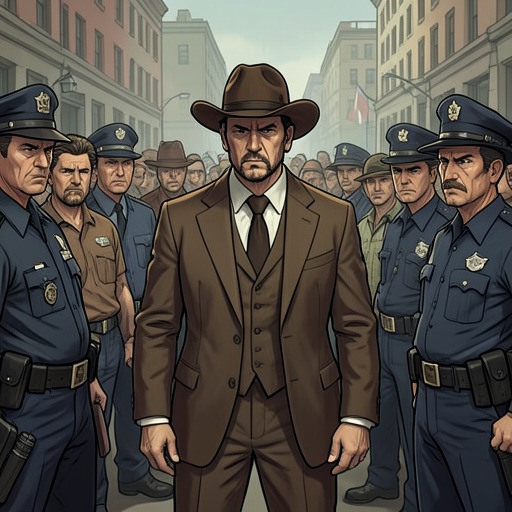
The Satanic VersesStephen Kinch, an inspector in the Brickhall constabulary and its community liaison officer, becomes a public face of police authority at moments when official explanations are fiercely contested. He presents the death of Uhuru Simba as an extraordinarily unlikely accident, later advances a copycat theory about the Granny Ripper murders, and links two fires while offering several possible motives. Across these episodes, his statements meet a community already alert to unequal treatment and a narrative that exposes the distance between an official account and what it can establish.
Position in Brickhall
Kinch’s role is both institutional and public-facing: he speaks for the police to a community in which trust has deteriorated. When Simba dies in custody while awaiting trial, Kinch describes the death as a chance occurrence of almost inconceivable improbability. That formulation gives the incident the shape of an accident before the public argument over its circumstances has been resolved. The account that follows places Kinch’s words before an angry crowd outside the High Street police station, where they become the focus of a challenge rather than a reassurance.
The narration also shows that Kinch is not wholly secure within the institution he represents. His fellow officers subject him to demeaning nicknames, and the account presents him as liable to be kept uninformed and made to absorb public blame. This detail complicates his authority: he speaks for the police, but is himself diminished within its hierarchy. It does not erase the power attached to his office, or settle whether his explanations are accurate; instead, it sets his position between institutional loyalty and vulnerability to colleagues’ contempt.
The dispute over Uhuru Simba’s death
Antoinette Roberts, Simba’s mother, takes Kinch’s description of the death as a point of departure for a broader accusation. She argues that the language of odds treats the community’s survival as something to be gambled on, and challenges the implication that a Black man’s death in custody can be dismissed as an exceptional mishap. Her response makes Kinch’s choice of explanation politically consequential: the issue is not only what happened to Simba, but whose account is presumed credible.
Hanif Johnson, Simba’s solicitor, adds specific grounds for doubt. He points out that Simba was said to have fallen from the lower bunk, while the other bunk in the cell was unoccupied, leaving no independent witness to the death. He also disputes the assumption that a nightmare alone explains the screams heard by officers. These points do not prove an alternative account, but they expose what the official version leaves unresolved. Kinch is thus associated with a conclusion that the people closest to the case regard as insufficiently supported, while their objections gain force in a public gathering where grief and anger are already joined.
Camera, order, and public explanation
During the Brickhall unrest, television coverage presents Kinch as a recognizable figure of civic authority: a family man facing a difficult job. The camera’s framing lends human warmth to the inspector, while the sequence around him complicates that reassuring portrait. Police shields divide the reporter from the disturbances; images show the consequences of the conflict that Kinch’s account of security and public order does not encompass. The camera is not a neutral witness in this scene: its position behind the police line shapes what it can see, just as Kinch’s official role shapes the terms in which he describes events.
In his televised remarks, Kinch acknowledges that some young people may have grievances but argues that they should recognize the relative safety of life in Britain, contrasting it with conditions in Africa, Asia, and the Caribbean. He evokes Britain as a peaceful, industrious country and calls for greater protection for police. The contrast between this description and the images of injured people and emergency response gives the speech an uneasy double register. Kinch’s language treats unrest as a problem of order and perspective; the surrounding scene keeps visible the grievances and harms that such a perspective may push to the margins.
The Granny Ripper theory
After two further murders bearing the killer’s concealed signature, Kinch appears on television with a theory that a copycat has somehow discovered the details withheld from the public. He suggests that the new killer has taken up the role left vacant by Simba, who had been accused and convicted in public opinion before his death in custody. The sequence makes the theory especially charged: a man whose death remains disputed is made part of an explanation for subsequent crimes. Kinch’s account does not resolve the earlier dispute; it extends its consequences into another investigation.
The police commissioner responds to the murders by quadrupling the police presence in Brickhall and keeping enough officers in reserve that the capital’s football programme is cancelled. The account does not say Kinch ordered these measures, but his public theory forms part of the circumstances in which they occur. Hanif Johnson calls the increased presence provocative, while young Black and Asian residents gather to confront patrol cars. Kinch’s explanation therefore sits within a widening cycle: murder prompts a theory, the theory accompanies intensified policing, and the increased police presence becomes another source of conflict.
The fires and the limits of certainty
Kinch later issues a statement connecting the fire at the Brickhall Community Relations Council with the fire at the Shaandaar Café. He notes that the dead woman worked for the council and that the dead man had been a semi-permanent resident at the café. From those circumstances he outlines possibilities rather than a settled motive: the man may have been the principal arsonist and the woman an accomplice; political intent could not be ruled out; or the fires may have had different purposes, including insurance fraud or an internal dispute. He also states that petrol was poured over office furnishings and that identification of the badly burned bodies required dental records.
The range of explanations shows Kinch doing more than announcing a conclusion: he makes uncertainty part of the official account. Yet the possibilities he lists invite suspicion as readily as they clarify the case, especially when the alleged political motives are linked to groups whose aims he says are difficult to discern. His recurring narrative role is accordingly not that of a detective whose account closes a mystery. He is the official interpreter of events whose causes remain disputed, and his statements reveal how public authority tries to impose coherence amid incomplete evidence, communal distrust, and escalating conflict.